If Hospitalists Are Not at the Center of Your Acute Strategy, You Have Already Lost

SNFists, hospitalists, and intensivists decide where acute and post-acute dollars are spent. Control those relationships, or the health system controls your cost.
By RaeAnn, Founder and Chief Executive Officer, HLTHWORKS
To every health plan CFO and network leader
If hospitalists are not at the center of your acute strategy, you have already lost. Not one contract. The whole acute and post-acute cost structure.
Hospital care is the largest line in American healthcare: $1.6 trillion in 2024, up 8.9 percent in a single year. Health systems are raising prices on health plans at the fastest pace in nearly two decades. And the physician who decides how much of that spend lands on your book is not in your network strategy, not in your contract, and not in the room when your value-based terms are written.
That physician is the hospitalist. The hospitalist writes the admission order, decides inpatient or observation, documents the diagnoses that set the DRG and the risk score, sets the length of stay, and signs the discharge that sends your member home, to a SNF, or back to the emergency department. The intensivist makes those calls on your sickest members. The SNFist decides whether a change in condition is treated in place or sent back to the hospital.
Today, the health system holds every one of those relationships. You pay for the outcome. They control it.
That ends with a direct contract. This article shows you how.
Read it with Articles 18 and 19. Article 18 showed how to reduce your MSK spend directly, rather than hand it to a vendor that profits from it. Article 19 identified transitions of care as one of the largest medical cost vulnerabilities health plans are now focused on. Both run through the same physician. If the hospitalist is not aligned with your plan, neither strategy runs on your terms.
Health plans built this model. Health systems took it.
The physician dedicated to one setting began as a health plan innovation. In 1987, EverCare put nurse practitioners on site with long-stay nursing home residents and cut their hospital admissions in half. It lives on today as the Optum care model. The hospitalist was named in 1996 and has grown to roughly 52,000 physicians, one of the five largest specialties in the country. Employer purchasers, through the Leapfrog Group, made intensivist-staffed ICUs a core safety standard. And SNFist use rose from 13 to 52 percent of the nursing homes studied between 2012 and 2019.
Health plans and purchasers created the facility clinician and the intensivist standard. The hospital absorbed the hospitalist. It is time to take that relationship back.
What I learned at Health Net and Scottsdale PHO
At Health Net and at Scottsdale PHO, now HonorHealth PHO, hospitalists were my best friends in driving care impact. They were not vendors to me. They were the people who made right patient, right bed, right length of stay actually happen.
We talked every day. We walked the census together. We knew which members were in the hospital, which ones should be in observation, which ones were waiting on a SNF bed, and which ones were waiting on a test that could be done Monday as an outpatient. When the discharge plan was weak, we fixed it before the member left the building, not after the readmission claim arrived.
Those consultations were not utilization management in the adversarial sense the industry uses now. They were clinical conversations between a plan medical director, a case manager, and the physician at the bedside. The hospitalist brought the clinical judgment. The plan brought the benefit design, the post-acute network, the home health options, and the full picture of the member’s history.
That model did not survive the shift to fax-based prior authorization, remote concurrent review, and algorithmic denials. We lost the relationship and replaced it with friction. Health plans should bring it back, updated for 2027.
The dollars they steer
Roughly 52,000 hospitalists, a smaller corps of intensivists, and a growing SNFist workforce steer the most expensive episodes in a health plan’s book. They do not bill most of that spend. They decide it.
Spend pool | Size | Who decides it | Source |
Hospital care, all payers, 2024 | $1.6 trillion, 31% of national health spending, up 8.9% | Admitting and attending hospitalist, intensivist in the ICU | |
Hospital growth, 2022 to 2024 | $277 billion, 40% of all national spending growth | Same | |
Fee-for-service Medicare SNF and swing bed care, 2024 | $34 billion across 1.5 million SNF stays | Discharging hospitalist, then the SNFist | |
One national hospitalist group’s share | About 6% of all acute medical hospitalizations in the US | Sound Physicians |
Medicare Advantage SNF spend sits on top of that fee-for-service figure. Private health plan spending on hospital care alone rose 10.4 percent in 2024.
For a CFO, the arithmetic is simple. Every point of inpatient length of stay, every avoidable observation-to-inpatient conversion, every SNF day that should have been a home health episode, and every 30-day readmission passes through a hospitalist’s order set. No other physician specialty touches that much of the medical loss ratio per encounter.
Who employs them now
A large share of hospitalists, intensivists, and SNFists no longer work for a community practice or for the hospital directly. They work for national medical groups, many of them backed by private equity or a strategic investor. That is the opening for health plans: these groups are contractable, measurable, and already selling value-based performance.
Company | Footprint | Services relevant to health plans | Ownership |
4,000+ clinicians, 400+ hospitals, about 6% of US acute medical hospitalizations | Hospital medicine, critical care and tele-ICU, post-acute telemedicine, long-term care ACO, BPCI history | Summit Partners, Silversmith, Revelstoke; Optum is listed among investors (CB Insights) | |
Acquired IPC Healthcare, a leading national hospitalist and post-acute group, for about $1.6 billion in 2015 | Hospital medicine, post-acute, emergency medicine | Blackstone since 2017 (PESP) | |
9,000+ clinicians, 14.5 million patients a year, 900+ practices | Hospital medicine, critical care, post-acute, Acute Care Transitions discharge program, hospital at home | Physician-owned partnership | |
1,000+ hospitalists; headquartered in Scottsdale | Hospital medicine | Physician-owned | |
1,600 providers across 34 states, 200,000+ seniors a year | SNF and long-term care medical group, ACO, and AllyAlign MA plans | Private | |
Institutional SNP care model, descended from EverCare | On-site NP and PA care in SNFs for MA members | UnitedHealth Group | |
115+ hospitals in 30 states, 120,000 patients a year | Tele-ICU, virtual nursing, telemetry | Private |
Notice what is happening. The hospitalist groups have built post-acute and discharge programs. The SNFist groups have built ACOs and health plans. Optum runs its own SNF care model and is listed among Sound Physicians’ investors. The physician groups are integrating across the transition. Most health plans are still contracting with them one hospital at a time, through someone else’s paper.
The problem: the hospitalist is buried in the health system contract
In most markets, the plan pays the hospital a facility rate and pays the hospitalist group a professional fee, often under the health system’s own agreement or a delegated arrangement. The hospitalist’s economic relationship runs to the hospital. The hospital’s interests and the plan’s interests are not the same.
Consider the incentives the hospitalist works under today:
- The hospital pays the subsidy. More than 95 percent of hospital medicine groups receive financial support from their hospitals on top of professional fees (SHM survey data), so the hospital funds the gap and sets the performance terms. Those terms reward throughput, documentation that supports the facility DRG, and inpatient status.
- Status is a revenue decision. Since 2024, Medicare Advantage plans must follow the two-midnight rule for inpatient admission criteria, though they keep the right to audit. The physician who documents the expected length of stay now shapes the plan’s inpatient exposure more directly than ever.
- Per diem contracts reward days. Where a plan still pays the hospital per diem, every extra day is revenue to the facility. The hospitalist who discharges on day four instead of day six is working against the hospital’s contract. DRG terms fix the day problem, but they still pay for every admission. Nothing in either model pays the physician to prevent the next admission, the avoidable SNF stay, or the readmission.
- Readmission risk is now shared on MA members. Beginning in fiscal 2027, CMS calculates Hospital Readmissions Reduction Program ratios using both fee-for-service and Medicare Advantage stays. Medicare will cut payments to 2,334 hospitals in fiscal 2027. The plan’s members now move the hospital’s penalty, and the plan has no direct contract with the physician who signs the discharge.
The result is a plan that pays for the outcome without a seat at the table where the outcome is decided.
What health systems want, and why it is not what you want
Health systems are rational operators. They want three things from your members, and none of them is a lower medical loss ratio for your plan.
- Utilization that creates revenue. Admissions, procedures, imaging, and days. Under per diem and fee-for-service terms, every one of them is revenue.
- A lower readmission percentage. That is not the same as fewer members coming back. The Hospital Readmissions Reduction Program counts unplanned inpatient readmissions. A return managed in observation, or treated and released from the emergency department, does not count against the hospital. Your plan still pays for it.
- Higher prices, faster than ever. CMS reported that 2024 saw the fastest hospital price growth since 2007. Private insurance prices for hospital care rose 30 percent from April 2019 to April 2026, against 21 percent for Medicare. PwC found that covering a 6 to 7 percent rise in health system operating expense would take a commercial rate increase of nearly 14 percent. In one public dispute, Anthem said Mount Sinai demanded a 50 percent rate increase.
Every one of those three runs through the hospitalist’s orders. The health system knows it. That is why the hospital pays the hospitalist subsidy and writes the hospitalist’s performance terms.
The hospitalist is your best indicator of value-based performance
If you want to know whether a health system is doing value-based care or only signing value-based contracts, look at its hospitalists. Ask four questions at your next joint operating committee:
- Are the hospitalists measured on avoidable days, observation accuracy, and all 30-day returns, including observation and emergency department returns? Or on throughput and RVUs?
- Do they know, on admission, which patients are your members?
- Do they talk with your medical directors and case managers every day?
- Do discharge summaries reach your plan and the primary care physician within 24 hours?
A system that answers no is selling you a value-based contract while running a volume model. The hospitalist is the tell. The hospitalist is also the fix.
The redesign: seven moves for network and finance leaders
The fix is not more prior authorization, and it is not only a change in facility payment. Whether a hospital is paid per diem or DRG, the health plan needs a direct contract with the physicians who control the stay, built on aligned incentives, measured outcomes, and shared value.
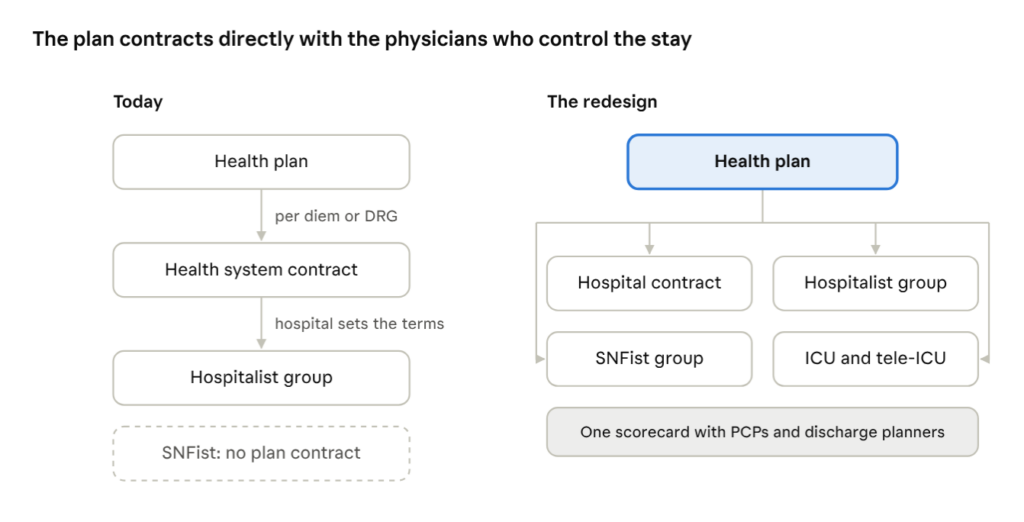
Today the plan reaches the hospitalist only through the hospital’s contract. In the redesign, the plan holds a direct agreement with each physician group, whatever terms the facility is paid on.
- Carve the hospitalist out of the health system agreement. Contract directly with the hospitalist group, whether it is a national medical group or an employed program, under its own professional agreement. Keep the facility contract for the facility. The physician who controls status, length of stay, and discharge should have a performance relationship with the plan that pays for them.
- Align each hospitalist agreement to that hospital’s reimbursement model. Per diem or DRG, there is no need to renegotiate facility terms first. The HLTHWORKS hospitalist contracting model builds each agreement uniquely to the hospital’s reimbursement model. Under DRG, the plan is not paying by the day, so avoidable days drop out of the incentive. Under per diem, they stay in. Either way, the agreement pays the hospitalist directly for the outcomes the plan is buying:
- Avoidable admissions prevented, and avoidable admissions redirected to the right setting
- Direct admission to a SNF when the member does not need an acute stay
- Appropriate use of observation
- RAF accuracy
- SNF length of stay and SNF readmissions
- Discharge to home
- Follow-up within 24 hours and within 7 days
- 30-day readmission
- Align the five decision makers on one scorecard. Hospitalists, intensivists, SNFists, primary care physicians, and discharge planners each control part of the same decision: whether the member is admitted, when they leave, where they go, and whether they come back. Pay them on the same measures the hospitalist agreement uses, so every decision maker is working toward one result.
- Bring back the daily clinical consultation. Replace remote, fax-based concurrent review with a plan medical director and case manager who round with the hospitalist group, in person or by video, on every plan member in the census. The conversation is clinical, not adversarial: what does this member need, and what can the plan make available today that the hospital cannot.
- Add an inpatient Annual Wellness Visit. Use the stay. Many members, especially those who rarely see their primary care physician, are most reachable while they are in the hospital. An AWV-style assessment by the hospitalist team before discharge captures a complete problem list, medication reconciliation, functional and cognitive status, social needs, and open care gaps, then hands that record to the PCP and the plan. It supports accurate risk adjustment, closes quality gaps at the source, and gives the discharge plan what it needs to hold. The plan funds it under the direct contract.
- Build the lines of communication that rebuild clinical protocols. Set a standing clinical forum: hospitalist, intensivist, SNFist, PCP, and discharge planning leads with the plan’s medical directors, meeting monthly on the plan’s own data. Use it to rebuild the protocols that drive cost: observation versus inpatient criteria, ICU step-down timing, SNF versus home health placement, discharge medication reconciliation, and seven-day PCP follow-up. Protocols written together are protocols followed.
- Sign the same kind of direct contract with SNFists and intensivists. The SNFist decides whether a change in condition is treated in place. The intensivist decides the sickest stays. Each needs its own direct agreement with aligned incentives, outcomes, and value, with tele-ICU and post-acute telemedicine coverage written into the network where on-site coverage does not exist.
None of this requires a plan to own physicians. It requires a plan to treat them as the operating partners they already are.
Risk adjustment, quality gaps, and readmission exposure
The hospitalist is also the most underused partner in the plan’s revenue and Stars strategy.
Risk adjustment accuracy. An inpatient stay is the most complete clinical assessment many members will have all year. The hospitalist’s history and physical, progress notes, and discharge summary document chronic conditions with the specificity that supports an accurate risk score. When that documentation stays inside the hospital’s record and never reaches the plan or the primary care physician, the plan loses accuracy and the member’s next clinician loses context. Accuracy is the goal, not volume. A direct relationship lets the plan support complete, compliant documentation and receive the discharge summary in time to act on it.
Quality gaps. Medication reconciliation after discharge, transitions of care, follow-up after an emergency department visit, and plan all-cause readmissions are HEDIS and Stars measures. Each one starts with what the hospitalist and the discharge planner do on the last day of the stay. A plan that wants those measures to move has to work upstream of the claim.
Readmission vulnerability. Readmissions are where the plan’s cost, the hospital’s penalty, and the member’s experience collide. With Medicare Advantage stays now in the HRRP calculation, the hospital has a new reason to partner with the plan on its members. That is leverage network leaders should use in the next renewal.
Why Articles 18 and 19 matter now. Article 18 showed that a health plan can reduce MSK spend itself instead of paying a vendor to manage it. That only works when the physician who co-manages the surgical stay, sets its length, and decides between home and a SNF is aligned with the plan. Article 19 identified transitions of care as one of the largest medical cost vulnerabilities in the book. That vulnerability opens the moment the hospitalist signs the discharge. In both, the hospitalist is the control point. If you have not read them, start there. Then call HLTHWORKS.
The Standard: what good looks like
A health plan that has rebuilt this relationship can answer yes to each of these:
- We hold a direct professional agreement with the hospitalist group at each of our top ten hospitals by plan spend.
- We hold direct agreements with SNFist and intensivist groups that pay for outcomes and value, whether the facility is on per diem or DRG.
- Hospitalists, intensivists, SNFists, PCPs, and discharge planners share one scorecard on avoidable admissions, observation use, RAF accuracy, SNF length of stay and readmissions, discharge to home, 24-hour and 7-day follow-up, and 30-day readmission.
- A plan medical director or case manager talks with the hospitalist team every day about every plan member in the census.
- Discharge summaries reach the plan and the primary care physician within 24 hours.
- Every admitted member receives an inpatient AWV-style assessment before discharge, shared with the PCP and the plan.
- A monthly clinical forum of hospitalist, intensivist, SNFist, PCP, and discharge planning leads rebuilds our acute protocols on our own data.
- Our tele-ICU and post-acute telemedicine coverage is written into the network, not left to each hospital.
- Our CFO can name the hospitalist group that controls our largest inpatient spend, and has met its leaders.
If your plan cannot check most of these boxes, the acute cost structure is being managed by someone else’s contract.
Diagnosis without a next step is entertainment.
The next step is a conversation. If you are a health plan CFO, a chief network officer, or you lead provider contracting, or you run an ACO or MSO that carries acute and post-acute risk, call HLTHWORKS or email raeann@hlthworks.com to get this right in 2027. HLTHWORKS helps plans map which physicians control their acute spend, align hospitalists, intensivists, SNFists, PCPs, and discharge planners, stand up the inpatient AWV, and build direct, value-based physician agreements that hold up under per diem or DRG facility terms.
Sources
- CMS, National Health Expenditures 2024 Highlights
- KFF, Hospital Spending Accounted for 40% of the Growth in National Health Spending, Feb 2026
- HFMA, US healthcare spending growth 2024
- MedPAC, SNF payment adequacy, January 2026
- The Hospitalist, State of Hospital Medicine: five things to watch
- ACP Hospitalist, Hospitalist workforce grew steadily 2012 to 2019
- Relias Media, EverCare cuts hospital stays
- Leapfrog Group, ICU Physician Staffing fact sheet
- Penn LDI, Nursing homes that hired SNFists
- AHA, CMS finalizes CY 2024 Medicare Advantage rule
- CMS, FY 2027 HRRP payment reduction methodology
- Becker’s, Where readmission penalties hit hardest
- Sound Physicians, The Sound Story
- TeamHealth and IPC Healthcare, SEC Form 8-K, 2015
- Vituity
- Apogee Physicians careers
- Curana Health summary, AHCA
- Hicuity Health, Baptist Health tele-ICU expansion
- KFF, Hospital Prices Have Risen Much Faster for Private Insurance Than Medicare Since 2019, May 2026
- HFMA, PwC on commercial rate increases needed to cover expense trend
- NBC News, Hospitals and insurers are fighting over money
- The Hospitalist, Are hospitalists being more highly valued? (SHM State of Hospital Medicine data)
HLTHWORKS builds artificial intelligence governance, scalability, sustainability, oversight, audit readiness, and a mature enterprise solution for medical groups, health systems, health plans, payers, and the vendors, plus investors serving them.